

My Security and Privacy-First Hosting Philosophy
Security and privacy in hosting are often treated as add-ons - features you enable once the real work is done. I see it differently. Hosting is a chain of trust, and every link is an opportunity either to reduce risk or quietly accumulate it. My philosophy is simple:
- Minimise trust,
- Minimise data, and
- Minimise blast radius.
If something fails, and eventually something will, the damage should be contained, observable and recoverable.
1. Data minimisation by design
The most secure data is the data you never collected. This is not just instinct; it is embedded in regulation. The UK GDPR formalises data minimisation as a core principle, requiring personal data to be adequate, relevant and limited to what is necessary. In practical hosting terms, this means questioning default log retention periods, disabling unnecessary telemetry, and resisting the urge to “keep it just in case”.
Logs are invaluable for debugging and incident response, but they are also high-value targets. A breach that exposes full IP histories, session identifiers or email addresses is not a technical footnote - it is a privacy failure. My default stance is short retention, structured logging and aggressive redaction. If it does not serve a defined purpose, it does not stay.
2. Defence-in-depth, not blind faith
No single control deserves blind trust. Firewalls fail. Patches are missed. Humans click things. A layered approach - often described as defence-in-depth - reduces reliance on any one mechanism.
In practice, this means combining network segmentation, hardened base images, timely patching and strict access control. It also means isolating workloads. Virtualisation and containerisation are powerful tools, but isolation boundaries must be understood rather than assumed. Shared infrastructure can be safe, yet only when the separation model is properly configured and monitored.
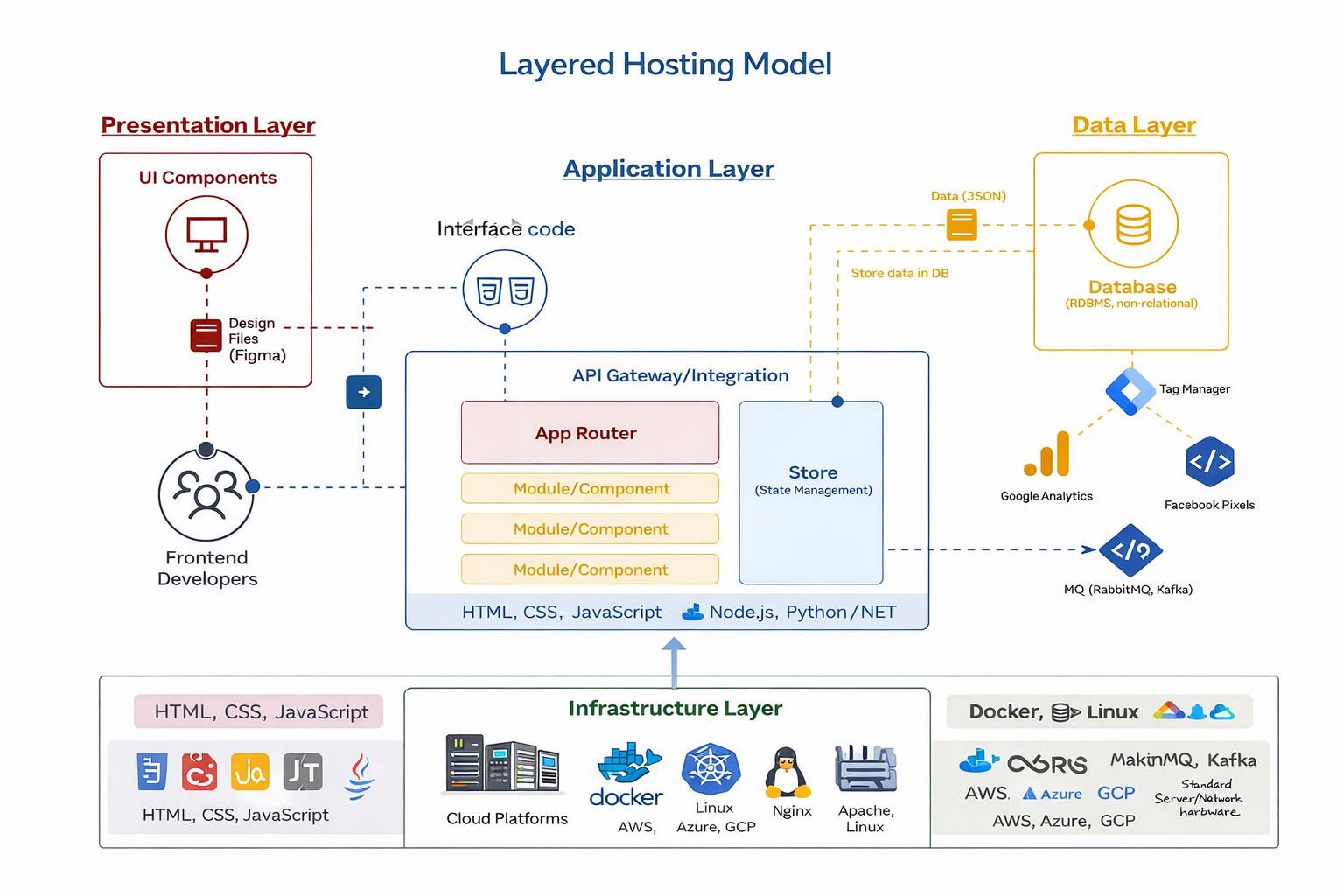
Each layer carries its own controls. The philosophy is straightforward: assume one will fail, and design the next to contain it.
3. Least privilege as a cultural norm
Least privilege is frequently cited and quietly ignored. Access accumulates. Admin roles linger. Shared credentials survive “temporarily” for years. Yet guidance from NIST emphasises limiting system access to authorised users and processes based on least privilege principles.
In my hosting approach, privileged access is treated as hazardous material. It is time-bound where possible, protected with strong authentication, and logged in a way that is itself access-controlled. Multi-factor authentication is not optional for administrative access; it is baseline hygiene.
Importantly, service-to-service permissions are constrained as tightly as human accounts. A compromised application should not automatically expose the entire estate.
4. Encryption that does not rely on hope
Encryption in transit is table stakes. TLS misconfiguration, however, remains common enough to warrant attention, and authoritative guidance continues to stress secure configuration and certificate management.
Encryption at rest is equally critical, particularly in cloud-hosted environments where storage is abstracted and portable. NIST describes encryption as a key mechanism for protecting confidentiality where data is stored on shared or external systems.
However, encryption is only as strong as its key management. My philosophy separates data from keys wherever possible, restricts key access to the minimum viable set of services and individuals, and rotates keys with discipline. “Encrypted” should never mean “we set it once and forgot about it”.
5. Observability with privacy guardrails
Monitoring is essential for security. Without visibility, there is no detection, and without detection, breaches linger. Yet observability can easily drift into surveillance.
The balance lies in purpose limitation. Collect metrics and security events that support resilience and incident response, but avoid building behavioural profiles without necessity. Retention periods should reflect risk, not convenience. Access to monitoring data should be audited. The principle of data minimisation applies here as firmly as anywhere else.
6. Resilience is a security feature
Backups are often filed under operations rather than security, which is a mistake. The ability to restore clean systems rapidly is a direct countermeasure to ransomware and destructive attacks. The NCSC highlights the importance of tested backups and recovery planning as part of cyber resilience.
In my approach, backups are encrypted, access-controlled and regularly tested. Immutable snapshots, where available, reduce the risk of tampering. An untested backup is merely a comforting assumption.
Table 1: Hosting decisions and privacy impact
| Log retention | Exposure of personal data post-breach | Short, purpose-driven retention | 30-day default with redaction |
| Admin access | Lateral movement after compromise | Least privilege and MFA | Role-based access with MFA |
| Data storage | Unauthorised access to sensitive records | Encryption at rest and segmentation | Encrypted volumes and VPC rules |
| Monitoring | Excessive profiling | Collect what is necessary only | Aggregated metrics over raw data |
Ultimately, a security and privacy-first hosting philosophy is not about perfection. It is about discipline. It assumes breach, designs for containment, and treats personal data as something entrusted rather than owned. In a market where trust is fragile and scrutiny is rising, privacy-first hosting is not just ethical, it is strategic.
Sources:
Ministry of Justice Security Guidance: https://security-guidance.service.justice.gov.uk/cryptography/#cryptography
National Cyber Security Centre: https://www.ncsc.gov.uk/guidance/using-tls-to-protect-data
Information Commissioner’s Office: https://ico.org.uk/for-organisations/uk-gdpr-guidance-and-resources/data-protection-principles/a-guide-to-the-data-protection-principles/data-minimisation
National Cyber Security Centre: https://www.ncsc.gov.uk/collection/mfa-for-your-corporate-online-services
National Institute of Standards and Technology: https://nvlpubs.nist.gov/nistpubs/Legacy/SP/nistspecialpublication800-144.pdf
National Institute of Standards and Technology: https://csrc.nist.gov/pubs/sp/800/53/r5/upd1/final
0 Comments