

The Illusion of Cheap Hosting
Cheap shared hosting is often marketed as the perfect starting point for small businesses and personal projects. For just a few pounds per month, hosting providers promise websites that are fast, reliable, and simple to manage. The value proposition seems obvious. Why pay more for infrastructure when a budget hosting package appears to deliver everything required to get a website online?
However, the low price of shared hosting is made possible by a particular architectural choice. Instead of allocating dedicated infrastructure to each customer, providers place hundreds of websites on the same physical server. Every customer shares the same operating system environment, the same core services, and the same pool of system resources.
For hobby sites this arrangement may be perfectly acceptable. For organisations that rely on their websites to support revenue, customer interaction, or brand reputation, the model introduces risks that are rarely visible at the point of purchase.
From a security and privacy engineering perspective, cheap shared hosting often represents a classic example of false economy. The monthly cost appears low, but the architectural compromises behind that price can expose organisations to security, reliability, and reputational risks that are far more expensive in the long term.
How Shared Hosting Actually Works
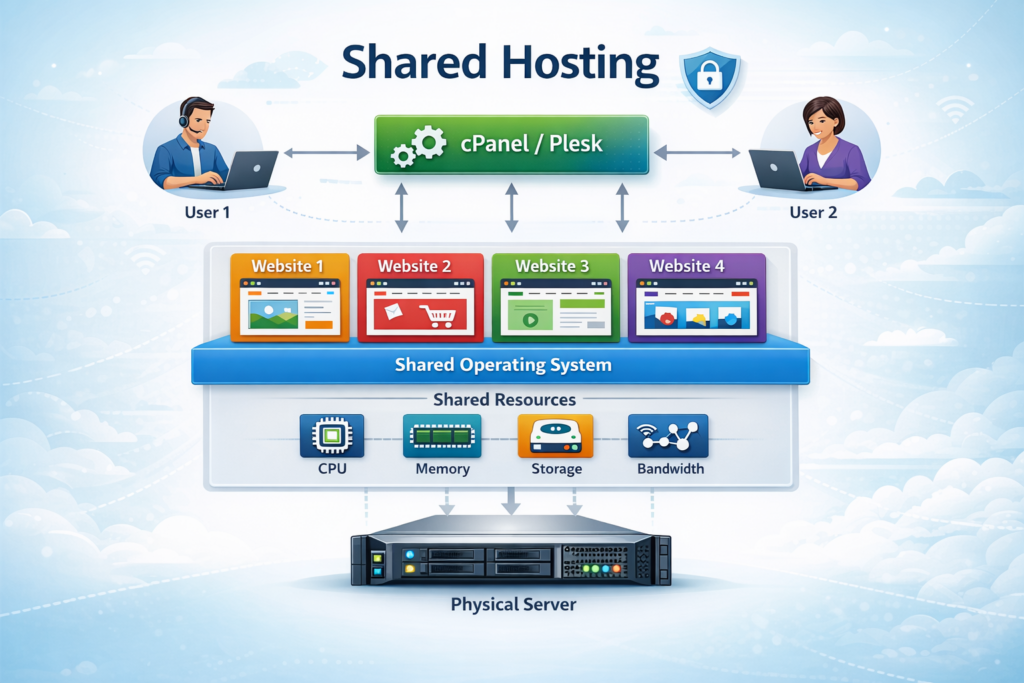
Shared hosting operates on a multi-tenant infrastructure model. A single physical server runs one operating system and a common web hosting stack, typically including a web server such as Apache or Nginx, database services, and a hosting control panel. Multiple customers are then placed within that environment, each running their own website while sharing the same underlying platform.
This design allows hosting providers to maximise the use of server hardware while keeping costs low. By distributing computing resources across many customers, providers can offer extremely inexpensive hosting plans.
However, several key components remain shared across every tenant on the system.
| Shared Component | Why It Matters |
| Operating system kernel | Vulnerabilities at the kernel level can potentially affect all tenants on the server. |
| Web server software (Apache or Nginx) | Misconfigurations or module vulnerabilities may expose multiple websites simultaneously. |
| Resource pools (CPU, RAM, I/O) | Heavy traffic or malicious activity on one site can degrade performance for others. |
| Network environment | Attackers may be able to perform lateral reconnaissance within the shared infrastructure. |
While modern hosting platforms attempt to isolate accounts using permissions and account-level restrictions, the separation is still weaker than that found in dedicated servers or properly isolated virtual machines. The result is an environment where the security posture of one website can influence the risk exposure of others.
Security Risks of Shared Infrastructure
The most significant drawback of shared hosting is not performance; it is security isolation. When multiple organisations operate within the same server environment, the attack surface expands dramatically. Even when providers implement safeguards, the underlying architecture means that one tenant’s security weakness can become everyone else’s problem.
In security engineering, this is known as a multi-tenant risk model. The integrity of the environment depends not only on the hosting provider, but also on the security behaviour of every other customer using the same infrastructure.
Several key risk categories emerge from this design.
Cross-Account Vulnerabilities
One of the most widely discussed risks in shared hosting environments is the potential for cross-account compromise. This occurs when an attacker gains access to one website on the server and then attempts to move laterally to other hosted accounts.
Historically, poorly configured file permissions and shared temporary directories have allowed attackers to read configuration files belonging to neighbouring websites. These files often contain database credentials or application secrets, which can then be used to compromise additional services.
Even where providers implement account isolation controls, vulnerabilities in the web server, control panel software, or operating system can still provide escalation paths.
Privilege Escalation
Shared hosting environments typically restrict users to limited system privileges. However, vulnerabilities within server software can allow attackers to escalate these permissions and gain deeper access to the underlying system.
Once elevated privileges are obtained, attackers may be able to:
- Access files belonging to other tenants
- Modify web server configurations
- Inject malicious scripts into neighbouring websites
- Establish persistent backdoors on the server
Because all hosted websites rely on the same operating system environment, a single privilege escalation vulnerability can potentially expose hundreds of sites simultaneously.
The “Noisy Neighbour” Problem
Security issues in shared hosting are not always caused by direct attacks. Sometimes the risk comes from what is known as the noisy neighbour effect.
Since server resources such as CPU, memory, and input/output bandwidth are shared between tenants, one compromised or poorly optimised website can degrade the performance of every other site on the server.
Examples include:
- A website infected with a cryptocurrency mining script
- A poorly configured plugin generating excessive database queries
- A compromised site being used to send spam or conduct botnet activity
In these scenarios, legitimate websites may experience slow response times, service interruptions, or even temporary suspension if the hosting provider detects abusive activity originating from the server.
Reputation and Blacklisting
Shared infrastructure can also create indirect reputational risks. If one website on the server is used for malicious purposes, the entire server IP address may become flagged by security systems.
This can result in:
- Email delivery failures
- Search engine trust penalties
- Web traffic filtering by corporate firewalls
In extreme cases, organisations may discover that their website is being blocked simply because it shares an IP address with compromised neighbours.
Isolation Comparison
The difference in security isolation between hosting models is significant.
| Hosting Model | Isolation Level | Security Risk Profile |
| Shared Hosting | Low - operating system and resources shared across tenants | High exposure to neighbour vulnerabilities |
| Virtual Private Server (VPS) | Medium - virtualised operating system environment | Reduced cross-tenant risk but still dependent on host security |
| Dedicated Server | High - full control of physical infrastructure | Strong isolation but requires proper configuration and management |
This comparison highlights why shared hosting often becomes a weak foundation for organisations that handle customer data, authentication systems, or business-critical services.
The architecture may be inexpensive, but it was never designed with strong security isolation as the primary goal.
The Hidden Costs Businesses Ignore
Cheap hosting plans are often presented as a practical starting point for small organisations. Paying only a few pounds per month for a working website seems like a sensible decision. However, the low price is made possible by sharing infrastructure with many other tenants, and this is where the hidden costs begin to emerge.
Shared servers distribute computing resources between multiple websites. As a result, performance and reliability are influenced by the activity of neighbouring tenants. If another site consumes excessive CPU, memory, or database resources, other websites on the same server may slow down or become temporarily unavailable. For organisations that rely on their website for sales, customer engagement, or lead generation, even brief downtime can carry financial consequences.
Security incidents can be even more costly. If a neighbouring website becomes compromised, attackers may attempt lateral movement within the server environment. Although hosting providers implement safeguards, the shared infrastructure model still increases the overall attack surface.
The consequences of a compromise may include:
- Website defacement or malware injection
- Theft of customer data or login credentials
- Search engine blacklisting
- Regulatory or compliance implications
- Loss of customer trust
Each of these outcomes can lead to both direct and indirect costs. Malware removal, incident response, and service recovery can quickly exceed the annual cost of more secure hosting infrastructure.
Cost Comparison: Cheap Hosting vs Security-Oriented Infrastructure
| Factor | Cheap Shared Hosting | Security-Focused Infrastructure |
| Monthly cost | Very low | Moderate |
| Infrastructure isolation | Minimal | Stronger isolation through virtualisation or dedicated resources |
| Performance reliability | Variable and affected by other tenants | More predictable resource allocation |
| Security exposure | Increased due to multi-tenant architecture | Reduced exposure through isolation |
| Incident recovery cost | Potentially high relative to hosting savings | Lower likelihood of cross-tenant incidents |
What this comparison highlights is that the savings offered by shared hosting often represent short-term cost reduction rather than long-term efficiency. When the risks of downtime, compromise, and reputational damage are considered, the financial advantage becomes far less convincing.
Why Hosting Should Be Treated as Security Infrastructure
Hosting decisions are often treated as routine operational choices, but in reality they form part of an organisation’s broader security architecture. Every application, database, and authentication system running on a website ultimately depends on the integrity of the infrastructure beneath it.
When that infrastructure is shared with hundreds of unknown tenants, organisations inherit risks that are largely outside their direct control.
More resilient hosting models, such as virtual private servers or managed cloud environments, provide stronger isolation between customers. These environments allow organisations to maintain greater control over system configuration, patch management, monitoring, and access policies.
The cost difference between shared hosting and these alternatives is often modest, yet the improvement in security and operational stability can be substantial.
Ultimately, cheap shared hosting is not inherently problematic. For personal blogs or small experimental projects it can be perfectly adequate. The difficulty arises when the same infrastructure is used for websites that handle customer data, financial transactions, or business-critical services.
In those situations, hosting should not be viewed as a commodity purchase. It should be considered part of the organisation’s security infrastructure, and the decision should be made with the same level of care applied to any other critical system.
Sources
OVH: https://www.ovhcloud.com/en/learn/what-is-shared-hosting/
NIST: https://csrc.nist.gov/pubs/sp/800/53/r5/upd1/final
OWASP: https://owasp.org/www-project-top-ten/2017/A6_2017-Security_Misconfiguration
Network Solutions: https://www.networksolutions.com/blog/what-is-shared-hosting/
Computer Networking [GitHub]: https://github.com/kowsertusher/Book/blob/master/Computer.Networking%20A%20Top-Down%20Approach%206th%20Edition.pdf
Microsoft Azure: https://learn.microsoft.com/en-us/azure/security/fundamentals/shared-responsibility
0 Comments